Carbohydrate Role
Whole Grains and the Longer Arc of Body Weight
Eleanor Whitfield · 12 February 2026 · 9 min

London, March 2026 — The argument between whole and processed food has been conducted loudly for decades, often generating more heat than information. What tends to get lost in the debate is the practical question: what, precisely, are the measurable differences between these two categories of food — and how do those differences register in the body over time?
The NOVA classification system, developed at the University of São Paulo and widely adopted in nutritional epidemiology, groups foods into four categories based on the extent and nature of their processing. The first group — minimally processed foods — includes whole vegetables, fruit, legumes, unprocessed meat, and eggs. The fourth group — ultra-processed products — includes industrially manufactured items that contain food-derived substances (emulsifiers, flavour enhancers, artificial colours, modified starches) rarely found in domestic kitchens.
Between these poles sit processed culinary ingredients (oils, flours, salted products) and processed foods (cheese, canned fish, preserved meats). The binary of "whole versus processed" captures only the extremes of this spectrum; the practical dietary choices most people make fall across all four categories.
What the NOVA framework enables is a more granular conversation about food quality than either calorie counts or nutrient panels alone provide. Ultra-processed foods are not defined by their macronutrient profile — they can be high or low in fat, carbohydrate, or protein — but by the industrial processes and added substances involved in their manufacture.
Processing reduces or eliminates certain components present in whole foods. High-temperature manufacturing can degrade heat-sensitive vitamins such as folate, vitamin C, and B vitamins. Extrusion processes used in snack food production alter protein structure in ways that can affect digestibility. The removal of bran and germ from grains to produce refined flour strips away the fibre, minerals, and phytonutrients concentrated in those layers.
Fortification — the addition of synthetic vitamins and minerals to processed foods — partially compensates for some of these losses, but the picture is more complex than simple replacement. The bioavailability of synthetic nutrient additions varies, and the food matrix in which nutrients occur in whole foods appears to influence their absorption in ways that isolated fortification does not replicate.
"Adding synthetic vitamin D to a breakfast cereal that has had its bran removed is not the same as eating the whole grain. The nutrient is present; the matrix is not."
Eleanor Whitfield — Ralek Review, March 2026
Energy density — the number of calories per unit of weight or volume — varies substantially across the food processing spectrum. Ultra-processed products tend toward higher energy density relative to their weight, partly because water has been removed (concentrating calories per gram) and because fat and sugar are common additives. The practical effect is that a small physical volume of ultra-processed food delivers a substantial caloric load, but may provide limited fibre, volume, or sensory satiation to suppress appetite effectively.
Whole vegetables and fruit occupy the opposite end of the energy density spectrum. A 200g serving of cucumber carries roughly 30 calories. The physical volume and fibre content of such foods contribute to stomach distension signals and the mechanical sensations that accompany satiety. The evidence on ad libitum eating — studies where participants eat freely without restriction — consistently shows lower total energy intake when diets are built around lower-energy-density whole foods.
Kevin Hall's randomised crossover trial at the NIH, published in 2019, provided direct experimental evidence for this mechanism. Participants consuming ultra-processed diets for two weeks ate an average of 500 calories per day more than those on unprocessed diets, despite reporting similar levels of hunger and fullness at the start of each meal. The effect appeared to operate below conscious awareness of quantity — suggesting that eating rhythm, rather than deliberate choice, was the primary variable being altered.
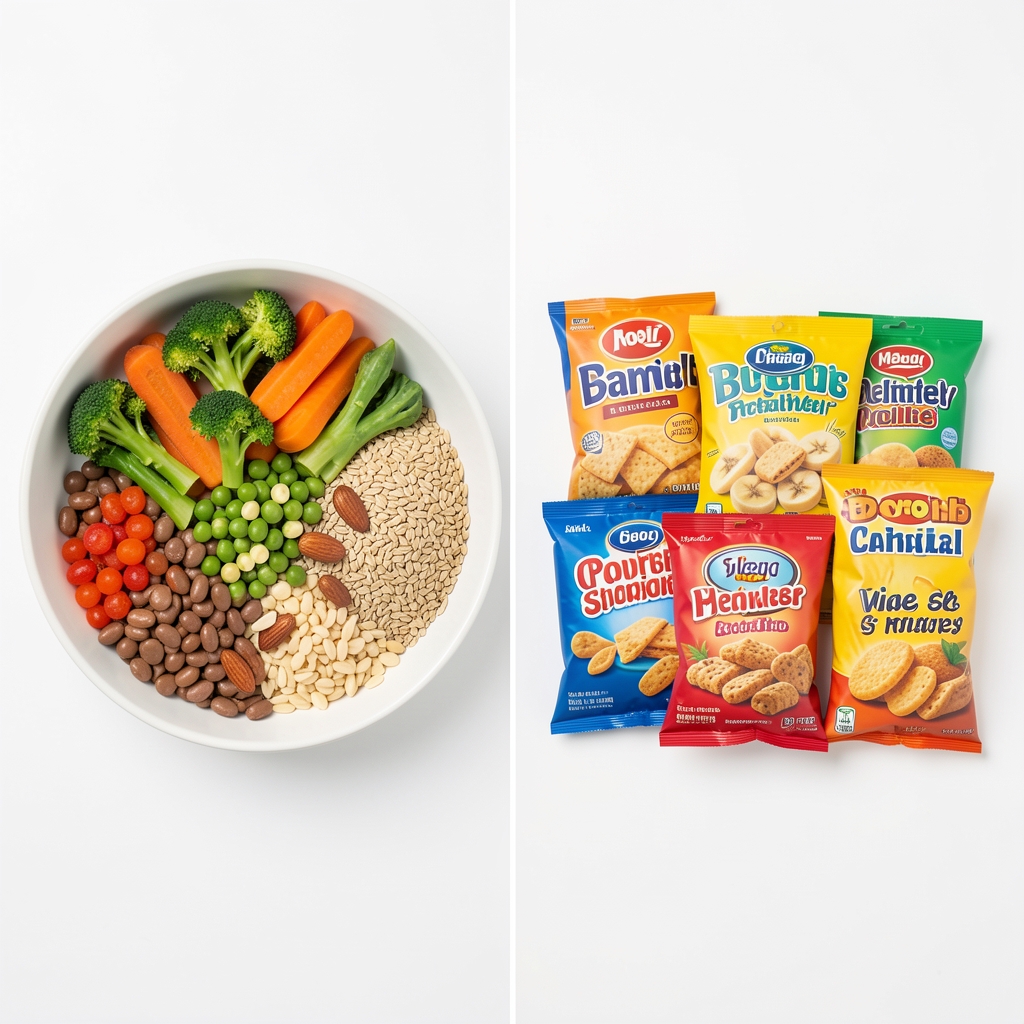
Added sugar is one of the most documented contributors to excess caloric intake in populations where ultra-processed food constitutes a large share of the diet. Unlike intrinsic sugars found in whole fruit — delivered within a matrix of fibre, water, and micronutrients — added sugar in processed foods typically comes without meaningful fibre content to moderate its absorption.
The sugar and weight management connection is not simply about calories. Liquid sugar — as found in sweetened beverages — bypasses normal satiety signalling more comprehensively than solid food, resulting in little compensatory reduction in subsequent food intake. Observational data consistently identifies sweetened beverage consumption as one of the more robust dietary correlates of long-term weight gain, independent of other dietary variables.
Solid processed foods high in added sugar present a somewhat different picture. Their contribution to excess caloric intake appears to operate primarily through displaced eating rhythm: high palatability drives consumption beyond the point of physiological need, a pattern that whole foods — with their greater fibre and water content and lower palatability engineered precision — are considerably less prone to producing.
The research on ultra-processed food and body weight does not present a case for elimination. It presents a case for awareness — for understanding the structural properties of food that make some eating patterns more compatible with comfortable weight maintenance than others. An occasional portion of biscuits or a supermarket ready meal does not, in isolation, constitute a meaningful risk. The cumulative composition of habitual eating is what shapes body weight over months and years.
Mindful portion habits, in this context, are not about rigid measurement. They emerge naturally from dietary patterns built predominantly around whole and minimally processed foods. When the bulk of a meal's composition comes from vegetables, legumes, whole grains, and quality protein sources, the energy density and fibre characteristics of that meal tend to produce appropriate portion regulation without deliberate counting.
The distinction between processed and whole is therefore most usefully understood not as a binary judgement about individual foods, but as a framework for understanding the structural properties of diets taken as wholes. A diet that habitually draws the majority of its calories from whole and minimally processed sources will tend to be lower in energy density, higher in fibre, more nutrient-rich, and more consistent in its production of appropriate satiety signals — and these characteristics, accumulated across months and years, shape the body weight picture more reliably than any single dietary intervention.

Eleanor Whitfield is a contributing editor at Ralek Review with a background in nutritional journalism and food policy research. She writes on the intersection of eating behaviour, nutrient science, and long-term body weight patterns.
More from this author →